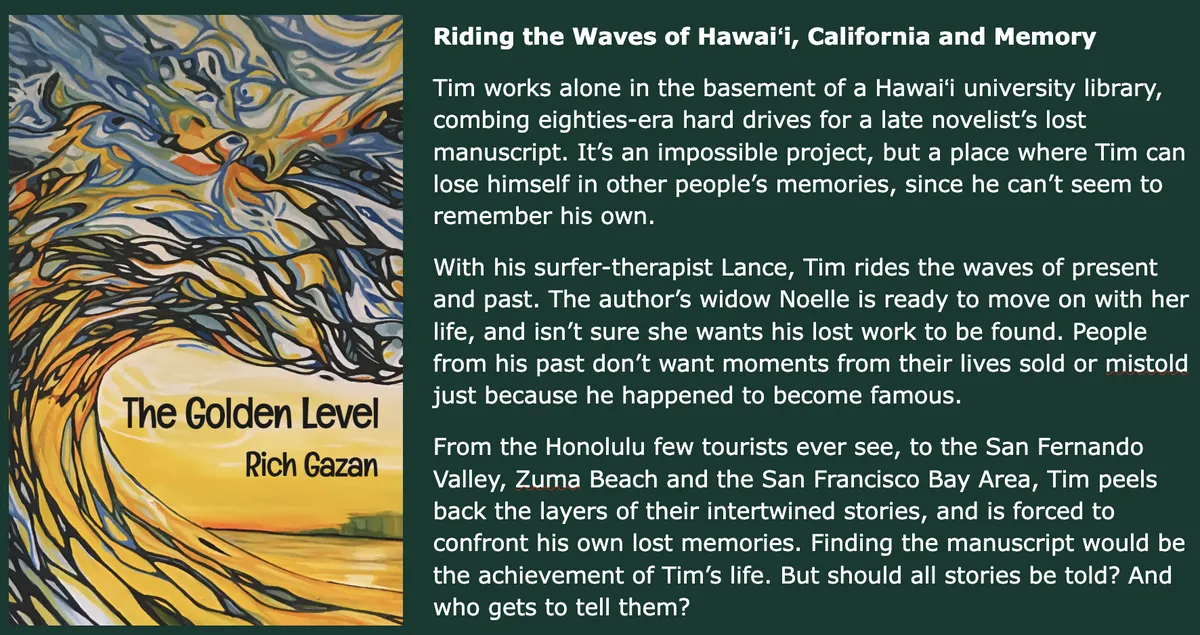
The Golden Level
Chapter 1: The Quiet
Beneath the canopy of monkeypods that lined the dark campus walkway, one basement window glowed differently. The person inside had rigged layers of thin cloth in blues and greens over the institutional fluorescent ceiling lights as if to create an underwater workspace. A computer screen illuminated a desk with a half-dozen ancient hard drives in various states of disassembly, alongside tiny connectors, wires and hand tools. Two tall steel bookcases held a rainbow of tattered computer manuals with thick, wrinkled spines and haphazard piles of magazines and printouts. More derelict hard drives spilled from open boxes on the floor, and stacks of identical sealed boxes grew eight high and three deep against the wall until they disappeared into the dark corners of the lab.
The cursor blinked patiently in the last field Tim had to complete: Percent Data Recovered. His neck creaked as he ran his hand through his graying brown hair, dimly noting the level of oiliness and its implications for how long it had been since his last shower. Without looking, he reached for a slim cable that hung from a makeshift pulley he’d fashioned from an old office chair wheel. He tugged at it until one of the ceiling cloths shifted and an amoeba-shaped spot of light splashed onto his pale yellow notepad with handwritten columns of numbers. It didn’t matter what the numbers were. Only that they changed with each report, to provide the illusion of incremental progress while maintaining hope of discoveries soon to come.
Eights were good. Eights had presence. They implied mass, thus achievement, but didn’t overpromise like nines did. Tim thought they looked like they were being given a gentle hug around the middle, which probably created some kind of subliminal bond in the viewer, so he put eights in all the reports and presentations he could.
Repairing and scraping eighties-era hard drives for data that might never have existed in the first place sounded like a mind-numbing project to everyone but Tim. He’d grown up with computers like these, and to him the soft chirp of old hard drives being accessed was as familiar and comforting as the sound of the ocean. Self-taught, he’d had enough promise to get admitted to Berkeley back when you didn’t have to be superhuman to get in, but he’d barely graduated with a least-effort social sciences degree and failed the only computer science class he ever took. But Hawaiʻi saw a Berkeley degree and made assumptions—the first of his many lessons about the academic ecosystem—and Tim ended up parlaying a temporary job into a permanent position.
His eyes felt older than his fifty-four years, strained by endless sessions abating rust, mold and critters in devices the size of a peanut butter sandwich, painstakingly fixing broken pins, scratched and corroded platters, dead cables and motors that didn’t spin. But taking on this project had allowed him to cast off his usual job of putting out tech support fires all day, work solo in a lab and make his own hours. Most of his life he’d taken joy in discovering forgotten artifacts of everyday life, from thrift store cassettes and CDs with playlists that had meant something to somebody once, old photographs and scrapbooks, and random flea market finds that felt like they had history.
The cursor continued to wink.
Claiming eighty-eight percent data recovery under these conditions would make any knowledgeable professional call bullshit. Even seventy-eight percent would strain credulity with modern drives, let alone ones this old and neglected.
Tim narrowed his eyes at the screen. The truth was that the answer was absolutely fucking unknowable. All the university had cared about then was being able to boast that every dorm room was equipped with one of the newfangled computer machines, which they sourced from a combination of purchases, grants, donations and staff discards. They were all standalone machines, not networked.
When maintenance and replacement started getting expensive, the computers were routinely cannibalized for parts. After a few years, more students were bringing their own computers to campus, so one summer the old machines were abruptly decommissioned. Disposing of them would mean expensive secure data destruction to assure student record privacy, then there was the question of environmental impact—then, as now, the last thing the university needed was more student protests. The easiest solution was to have underpaid student workers cart the computers from the dorm rooms to a damp, forgotten warehouse, and let the next regime figure it out.
No one kept records. No one knew which computer had been in which room, how they were configured, how often components had been replaced, even what software had been run. They’d been able to locate and extract twelve hundred and two of the workhorse Seagate ST-225 hard drives, but just because they had 20MB capacity didn’t mean there was 20MB of data to extract from each one. And most students saved files on removable floppy disks then. Even with their agonizingly slow data transfer rate, the only way to print out an assignment was to walk your floppy disk downstairs to the main dorm lounge, to the only printer-connected computer in the building. Maybe you saved a version on the hard drive, maybe you didn’t.
Tim had the impulse to enter Absolutely Fucking Unknowable in the Percent Data Recovered field, then remembered that he was logged into their secure server to file this report, and they could easily monitor his keystrokes. As if to confirm their surveillance, the Still there? dialog box popped up, startling him, and he clicked Yes much harder than he had to.
Connected, the dialog box assured him with a needlessly animated icon. Thank you for your support of the Fritz Foundation.
Calvin Fritz, like many students who came to Hawaiʻi from elsewhere, had been in no hurry to graduate. He surfed and changed majors three times before returning to California and going to work for a bank. Only when he published his first short story fifteen years later, about a middle-aged man revisiting the southern California suburb where he grew up and lamenting its impermanence, did he resurface in anyone’s consciousness. The story caught the eye of a literary agent, and three years later his first novel, Rockford’s Firebird, about two friends who scrutinized exterior locations of seventies TV shows shot in southern California and had poignant misadventures trying to visit them decades later, became a modest, quirky hit.
The second novel was the breakthrough. Meredith had given Tim Two-Hit Harry as an anniversary gift, but he set it aside, suspicious that it was a Trojan horse for some Larger Message.
“No subtext,” she sighed. “You both grew up in LA and moved to Hawaiʻi. There’s surfing and weed in it. Read it or don’t.”
Tim read it twice and still wasn’t sure if the author was going for seriousness or camp. It had rapturously overwritten passages about the deep universal truths of experiencing music, the beach, talking with friends, all while high. But it also had things you normally didn’t see in these kinds of books, like women who enjoyed getting high, sympathetic authority figures, and the melancholy of being the last person in a room after a party had ended. It engaged honestly with some of the downsides of being stoned all the time, and the struggles of trying to build a life that balanced childlike wonder and adult responsibility. The Larger Message was that all that matters in life are shared moments of deep connection. It was a literate stoner comedy with a heart, and it caught the cannabis legalization wave at just the right time. And it was a damn good story.
As the accolades for the book accumulated, the university suddenly remembered Calvin Fritz was one of their own, so they invited him to campus to accept a distinguished alumni award. He arrived in Honolulu in mid-May, just as the first big swell of the summer was rolling into the south shore, and received the news that Two-Hit Harry had been optioned for a movie. Then, when everyone was paying attention, he gave that interview.
“I’m pretty happy with both books. But the first thing I ever wrote was on a dorm computer when I went here in the eighties. It’s lost forever. I still think about it.”
And later that week, having extended his visit to celebrate the movie deal and enjoy the summer waves with his family and friends, Calvin Fritz died. Surfing medium-sized waves at a friendly south shore break.
Of course his death made his book sales spike. A few crowdfunded proposals to find his lost work gained little traction until his widow Noelle established the Fritz Foundation and promised to match contributions dollar for dollar. In one early example of her shrewd leadership, she chose to launch the campaign on April 20. It met its funding goal in six hours.
The idea of a lost manuscript fired everyone’s imagination. He’d only referred to it as a “thing.” Did that mean a story, a poem, a class paper, a heavy metal opera? No one knew. He’d met Noelle long after his college years, and she said he’d never mentioned it to her.
When the Fritz Foundation and university administration sat down to plan how the project would be carried out, it did not go well. The foundation had a contract in hand with a data recovery company, and all they needed from the university was pickup logistics. The university cheerfully replied that they owned the machines and all the data on them. They saw the project as a research and learning experience, a part of their institutional history that would also be ideal for recruiting and alumni outreach. The physical machines and recovery work would stay on campus, and be conducted exclusively by university employees who had clearance to review what would obviously include protected student data. And while they would not even discuss yielding any intellectual property claims before the data was found, they would be happy to accept donations. How much could they count on the foundation to contribute?
The negotiations took years, and legal fees drained away much of the initial funding. As the balance dwindled and media interest waned, they finally settled on one university data specialist whose salary would be cost-shared: Tim. The library was happy to donate the lab space, since the basement had a computer-friendly chill and it fit the narrative of the library as a place containing secrets to be discovered. There was a press conference and a catered kickoff event with lab space tours for media and guests to make the project look much more well-funded than it was. The university, the publisher, the agents, the fans. Everyone was selling dreams to everyone else.
And now four years had passed with no results.
The only project-related contact Tim had had with the world outside the lab was completing this yearly report and reconfirming his acceptance of the workflow and non-disclosure agreements.
Tim had always been suspicious of anything that looked like ambition or achievement, but his willingness to do unglamorous, necessary work had gotten him twenty-seven years with the university. The thought of traveling back in time to unearth lost treasures made it easy to give this version of drudgery what passed for his best effort. In all those years, this was the only project he’d ever welcomed into his mind outside working hours. At this point he wondered if he was the only person left who remembered the project, let alone cared. And when it ended, there would be consequences for spending four-plus years away from his regular job.
Tim entered sixty-eight percent and clicked Submit. Time to go home and face his other bad decision.
Chapter 2: The Box
Tim leaned his too-small motorcycle through the left turn onto King Street and accelerated through the silky Honolulu night. With practiced rhythm, he inhaled as he passed the restaurants—Korean, Vietnamese, Thai, noodle houses, pizza joints—and exhaled as he passed the alleys where the trade winds blew the stench of urine and worse back through the homeless encampments that lined the sidewalks.
For as long as he was on the motorcycle, he was immune from texts, emails and every other form of human interaction, so he made most rides longer than they needed to be. But he eventually circled back to his Makiki neighborhood, where tall apartment buildings sprouted thickly, spilling from the mouth of Mānoa Valley around and up the base of Punchbowl Crater. He guided the motorcycle beneath a nondescript sixties-era medium rise building, and by the dim light secured the rear tire to a bulky chain that surrounded a weeping sewer pipe.
Four hours past sunset and still the cement and cinder block building radiated with the day’s heat. More rental Jeeps and convertible Mustangs invaded the parking lot each month, as speculators bought cheap units as vacation rentals. The gray lobby linoleum stubbornly maintained a hint of sparkle from the previous century, and the elevator had been appropriately tagged with a bumper sticker reading: Slow down…this ain’t the mainland. Tim rode up six floors then walked down the hallway, its tropical patterned carpet soiled and dark everywhere except the edges. The sounds of televisions, children, music and wheezing window air conditioners droned from behind each door as he passed. At the second to last door, he shifted his backpack on his shoulder, took a breath, and went inside.
Bright scarves and sarongs hung from the living room walls, surrounding upcycled hand-painted furniture and throw pillows in reds, oranges and yellows. Thriving plants overgrew from multicolored pots on floors and shelves, and a plug-in lava rock water feature burbled by the sliding glass door to the lanai. The walls were dominated by thrift store paintings that Meredith would enhance with her own colors and change regularly. Nothing seemed intentionally placed, which, she had explained to him in warmer days, was the point.
Meredith tended a plant in the corner as music played. Born and raised in Hawaiʻi, she’d been quick to tell him that didn’t make her Native Hawaiian—she was Japanese, Filipino and Portuguese. From these islands, but not of them. As he approached, he noticed her black hair now had purple highlights, but he knew from experience not to mention it, in case she’d had them for days or weeks already. He touched her shoulder, then gave her a tentative hug from behind. She stiffened but didn’t pull away.
“Can you get me a tie for this vine?”
He raided the junk drawer and returned with a tired, nearly paperless twist tie from a long-ago bag of bagels.
“Not this.”
Of course not this.
Even facing away from him, she caught it.
“The wire is going to slice into it. Can you get a strip of cloth?”
“Any particular thread count?”
“Pretend the plants are old hard drives.”
The barbs. At least that hadn’t changed. He returned with the cloth.
“Had to finish the report. Sorry.”
“No you’re not.”
Tim looked toward the ceiling. “Starting the clock?”
Meredith turned and faced him. “Deborah said ten minutes of radical honesty a day. You said you don’t want to get into things right before bed, so I’m trying to honor that.”
“If I’m being radically honest, I’d like to have a conversation with my wife that hasn’t been scripted by a therapist.”
“If we could do that we wouldn’t be seeing her. And can you not say things you don’t mean, like you’re sorry? Clock hasn’t started yet.”
“I’d like to come home to peace instead of conflict.”
“This isn’t conflict, it’s communication.”
“We’re in conflict over whether we’re in conflict.”
“Stop trying to be right!”
Tim’s neck tightened as the room filled with familiar silence. He looked out the sliding glass door, through the dark space between the neighboring buildings to the ocean. They’d been able to see a lot more of it when they bought the place, but subsequent construction had taken all but that sliver of the view they’d fallen in love with.
“You’d rather be by yourself in a basement working on a project you’ve said is pointless.”
“I enjoy that pointless project. Plus it’s quieter at night. The bandwidth is better.”
She closed her eyes.
“You’re fixing hard drives. You know bandwidth doesn’t matter.” She looked toward the kitchen clock. “God, Tim. You couldn’t make two minutes.”
Thanks for reading! Longer excerpts (some even book length!) can be found at Amazon, Barnes & Noble and many other places.
Email is always welcome.